A Signature in Every Pocket: Decoding Hermann Hauser's "Quiet Architect" Face
Türkçe: bu analizi Türkçe okuyun →
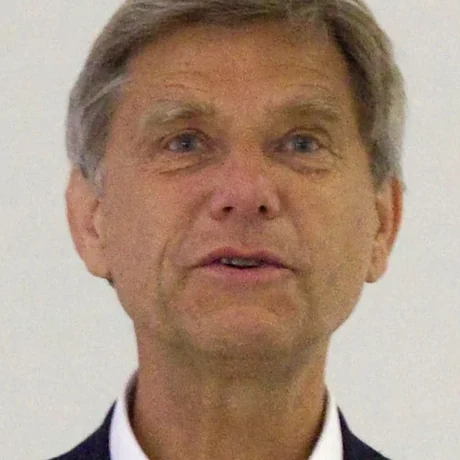 HHHermann Hauser
Photo: “Hermann Hauser (cropped)”, BadgerHero / Wikimedia Commons, CC BY-SA 3.0, adapted
This article preserves the physiognomy vocabulary I used when it was first published. In my current practice I treat facial morphology not as a definitive verdict on personality or behaviour, but as a communication hypothesis that must be verified through behaviour, context and questions.
See my current method →Inside the phone in your hand lives the forty-year signature of a man whose name you've probably never heard. Nearly every smartphone on Earth runs on the ARM architecture; and ARM was a company founded in 1990, in a barn near Cambridge, with twelve engineers. The man who opened that barn door was an Austrian-born physicist: Hermann Hauser. The man who co-founded Acorn Computers in 1978 and gave Britain's computer literacy campaign the BBC Micro (1981), who watered Cambridge's "Silicon Fen" through Amadeus Capital from 1997, and who, in 2020, raised a lone flag against Nvidia's $40-billion-turned-$87-billion bid for ARM.
While Silicon Valley's noisy prophets decorate headlines, why is the face behind one of technology's most enduring architectures so little known? The answer hides in that face itself.
1. The Broad, High Forehead: A Physicist's Cathedral Ceiling
The broad, open forehead rising above Hauser's glasses reads in physiognomy as wide-ranging interests, strong memory, appetite for learning, and intellectual thought; a high forehead adds strategic planning. A career that began with a Cambridge physics PhD and went on to fund everything from quantum computing to genomics is the work not of a merely curious forehead, but of one with a cathedral ceiling.
The evidence is a bluff that entered tech folklore: in 1981, when the BBC asked Acorn whether it had a working prototype for the national computer project, Hauser said "yes", there was no prototype. As the legend goes, the team built a working machine within days, and the BBC Micro contract was won. That wasn't a gamble; it was the calculation of a forehead that saw its own team's capacity more clearly than anyone.
2. Smiling Eyes Behind Glasses: The Mentor's Warm Lens
Hauser's eyes, smiling from behind glasses in nearly every photograph, are the polar opposite of the icy analytical gaze this column read in Peter Thiel. In my physiognomy experience, the eyes represent one's outlook on life; a smiling, curved eye area marks the build that forms bonds and delights in supporting others. The same analytical depth, delivered at an entirely different temperature.
The career counterpart of that warm lens is mentorship: at ARM's legendary founding in 1990, placing twelve engineers in a barn, in partnership with Apple and VLSI, Hauser chose the role of path-opener, not CEO. Over the next three decades he played the same role for hundreds of founders through Amadeus Capital. Recall Paul Graham's "gardener" face; Hauser is that gardener's Cambridge grandfather, one generation earlier.
3. Full Cheeks and Soft Lines: Earth That Returns to the Ecosystem
Hauser's rounded, full-cheeked face carries the signature of the Earth element in physiognomy: service, patience, stability, and the tendency to share what one has accumulated. Cheeks mark the reserve, but on this face, the reserve flowed less into a personal vault than into a regional ecosystem.
The numbers tell the story: Amadeus Capital, founded in 1997, has funded hundreds of deep-tech ventures over a quarter century; thousands of technology companies now operate in the region known as "Silicon Fen." Hauser tilled the same soil on Britain's and Europe's innovation councils, he was among the founding architects of the European Innovation Council. I once wrote about İşbecer's "service to the ecosystem" texture; Hauser is that texture at continental scale.
4. A Chin That Age Never Hardened: The Flag Raised Near Eighty
Hauser's soft-looking yet resolute chin fits the balanced-will type in my physiognomy experience: the build that doesn't impose its opinions but never flees a fight for its values. Its greatest test came in the autumn of his career: in 2020, when Nvidia moved to buy ARM, Hauser, in his mid-seventies, went to war in public. He wrote open letters, warned it would be "a disaster for Cambridge, the UK, and Europe," appealed to the Prime Minister, and launched savethearm.com. In February 2022 the deal collapsed; in 2023 ARM returned to Nasdaq as an independent company. A round-featured face doesn't enjoy a fight; but Earth does not forgive those who come to pull up its roots.
Conclusion: Water's Wisdom, Earth's Root
On Hermann Hauser's face, Water and Earth have kept a half-century balance: in the broad forehead and insatiable curiosity, Water's wisdom; in the full cheeks, smiling eyes, and a fortune returned to the ecosystem, Earth's service. ARM itself is this face's metaphor: invisible, modest, yet beating at the heart of nearly every device on the planet.
Perhaps that is technology history's real lesson: the most enduring empires are not the ones that plant flags, but the ones that grow roots. Tomorrow, in how many devices, how many people, will your work quietly keep beating?
The theme of quiet architecture, mentorship, and lasting impact in this reading of Hermann Hauser reaches beyond one founder; it also raises the question of who carries which role in a team and how different characters complete one another. To bring this perspective into your own founding or leadership team, explore Startup Team Architecture.
This theme in training: Startup Takım Mimarisi (Turkish) →