A $2.5 Billion Solitude: Decoding Markus "Notch" Persson's "Pixel Craftsman" Face
Türkçe: bu analizi Türkçe okuyun →
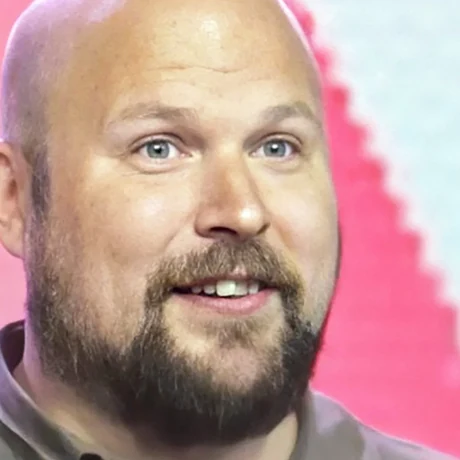 MPMarkus Persson
Photo: “Notch receives the Pioneer Award at GDC 2016 (cropped)”, Official GDC / Wikimedia Commons, CC BY 2.0, adapted
This article preserves the physiognomy vocabulary I used when it was first published. In my current practice I treat facial morphology not as a definitive verdict on personality or behaviour, but as a communication hypothesis that must be verified through behaviour, context and questions.
See my current method →One of the greatest success stories in gaming history was written not in a corner office but in the evening hours of a Swedish home. In 2009, Markus Persson was a salaried programmer by day; by night he was building a world of blunt, blocky cubes that nobody had ordered. That world became Minecraft: the best-selling video game of all time. When Microsoft bought Persson's studio Mojang for $2.5 billion in 2014, "Notch" was already a legend. But the message he posted that same period revealed the story's other face: "I don't want to be a symbol."
How does a person single-handedly build a universe inhabited by millions, and feel so alone in the middle of the crowd? In face reading, the answer is written across Persson's round, bearded, narrow-eyed face.
1. The Round Face and Full Cheeks: Earth of Comfort and Accumulation
The face beneath Persson's fedora is a clear example of the round form in my physiognomy experience: full cheeks, soft lines. A round face points to an emotional, impulsive build that values comfort and friendship; full cheeks mark the energy reserve and the capacity to accumulate.
That accumulation entered history quite literally: in 2010 he put Minecraft on sale as an unfinished "alpha", players paid for an incomplete game, and the game funded its own development. The marketing budget was zero; the patient accumulation those cheeks represent grew into a treasure passed by word of mouth.
2. Narrow, Small Eyes: The Detailer Who Weaves Pixel by Pixel
Persson's narrow, small eyes, nearly vanishing when he laughs, mark, in physiognomy, the analytical, detail-driven, "measure three times, cut once" mind: a person of the here and now, slow to open up. Graham's narrow eyes weeded out sentences; Persson's weed out pixels.
The evidence is the product itself: Minecraft's deliberately rough aesthetic is not laziness but the most refined balance of detail a single programmer could carry across a world of millions of lines. From 2009 until the official 2011 release, he coded nearly every block, every creature, every physics rule largely alone. Small eyes don't love crowds; they love depth.
3. The Soft, Beard-Framed Chin: The Craftsman Who Refused the Throne
The soft, slightly receding chin beneath that thick beard reads in my physiognomy experience as the introverted build, sensitive to criticism, preferring making over managing. The career matches the reading precisely: when Persson founded Mojang in 2010, he didn't take the CEO chair, he gave it to Carl Manneh and kept writing code. The creator of the world's most valuable game chose to remain, by title, "just a developer."
But physiognomy whisper the balance too: a receding chin can be fragile against the world's harshness. In 2014, when the angry waves of a massive player base and the weight of corporate responsibility grew heavy, Persson's answer was not to fight but to close the door: he sold Mojang to Microsoft for $2.5 billion and wrote in his farewell letter, "It's not about the money. It's about my sanity."
4. The Broad Forehead and That Famous Hat: Imagination Opened, Spotlight Declined
Persson's broad forehead hides under a fedora in most photographs. Physiognomy reads a broad forehead as imagination, strong memory, and intellectual curiosity, and covering the forehead as a tendency to decline mental responsibility. The pairing reads like a summary of the Persson story: boundless imagination, and flight from the stage light and the burden of being a symbol.
The post-sale years confirmed the tension: a period of drifting through social media storms, occasionally harsh public disputes, then long silences in the middle of a fortune. But the story didn't end there: in 2024 he announced a new studio, Bitshift Entertainment, and returned to making games. A craftsman feeds not on podiums but on his workbench, and Persson went back to the bench.
Conclusion: A Lone Water in Earth's Cellar
Earth and Water form a tense but productive partnership on Markus Persson's face: in the round face and full cheeks, Earth's accumulating, comfort-seeking, loyal texture; in the imagination and introverted depth, Water's creativity, and, as physiognomy warns, a flow that turns to fear when it rises too high. In the same industry, Paananen stayed balanced by distributing power; Persson carried it alone, and paid the bill alone.
Perhaps Minecraft's billions of blocks are telling us exactly this: some people are born not to rule the world, but to build worlds. What are you spending your blocks on, the castle wall, or the stage podium?
The theme of creativity, deep work, and the loneliness of visible success traced in this reading of Markus Persson goes beyond observing a portrait; it helps us notice the person earlier. To see how I read facial regions, character structures, and communication preferences together, explore my Physiognomy and Human Insight approach.
This theme in training: İnsan Tanıma & Yüz Morfolojisi (Turkish) →